
9 Critical Skills Every Procurement Officer Needs to Adopt to Become a Successful Procurement Specialist by 2027
To succeed in procurement by 2027, professionals must master 9 critical skills: AI fluency, spend analytics, ESG compliance, TCO calculation, risk mitigation, data-driven negotiation, strategic supplier relationships (SRM), contract lifecycle management, and cross-functional leadership.
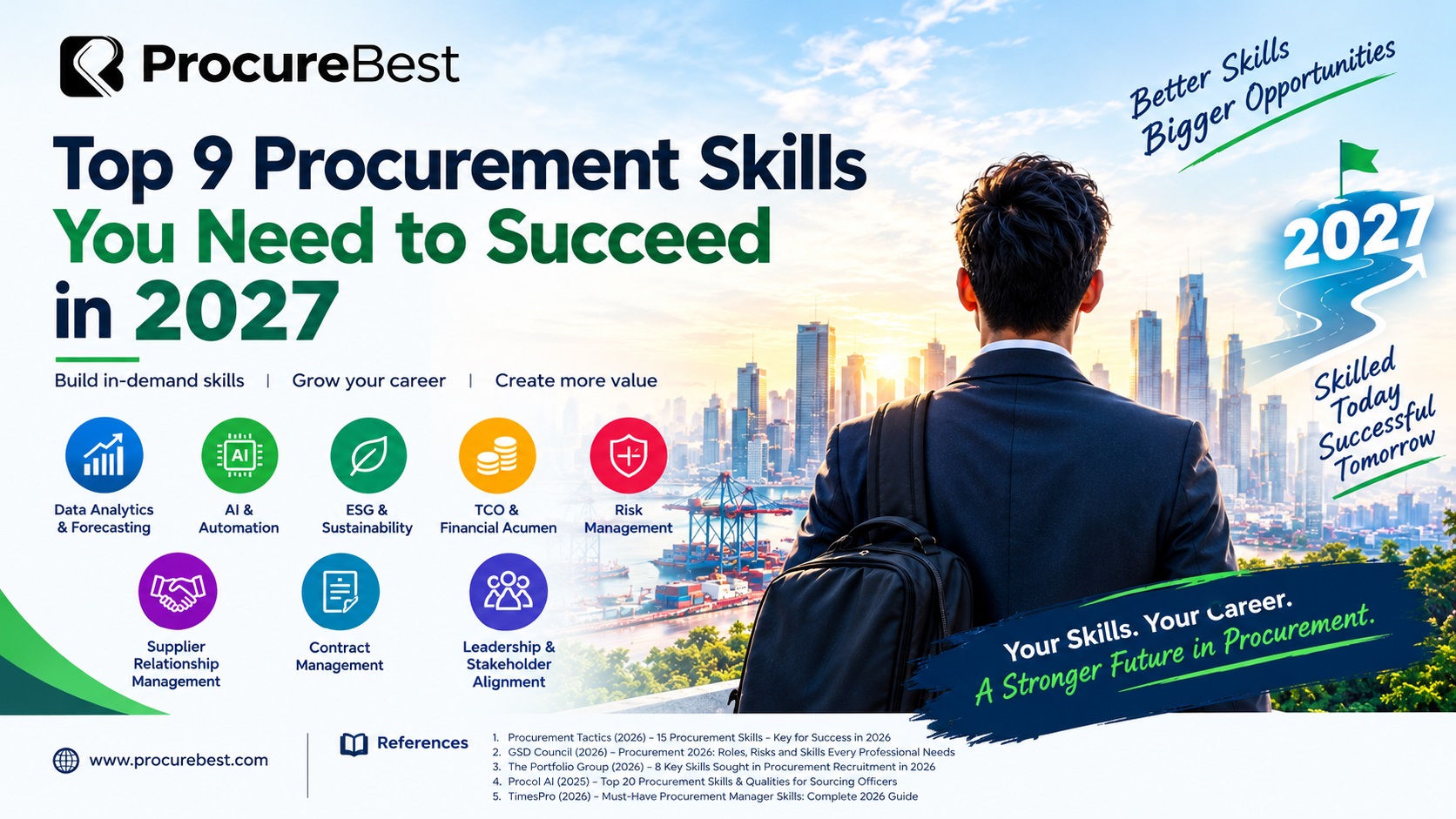
Modern procurement has officially transitioned from an operational cost center to a high-impact driver of business strategy. To meet the challenges of the 2027 market and advance your career, procurement officers must master these 9 essential, non-negotiable skills:
1. Advanced Spend Analytics & Predictive Data Modeling
Data is the lifeblood of strategic procurement. Procurement officers must look beyond historical spending patterns to build predictive models that forecast price fluctuations, identify consolidation opportunities, and eliminate cost leakage before purchase orders are issued.
- Real-World Example: Instead of reviewing annual spend retroactively, a procurement officer utilizes real-time ERP analytics to aggregate global tail spend across 12 business units, identifying duplicate vendor contracts and unlocking an immediate 14% cost reduction.
2. Practical AI & Process Automation Fluency
AI fluency in 2027 isn't about writing code—it’s about knowing how to integrate generative AI and machine learning tools into everyday workflows to automate vendor evaluations, generate market intelligence reports, and streamline RFP analysis.
- Real-World Example: A procurement officer uses an AI-driven sourcing tool to evaluate 40 international vendor proposals simultaneously, scoring risk metrics and pricing structures in minutes to accelerate contract award cycles from three weeks to 48 hours.
3. ESG Compliance & Scope 3 Decarbonization Strategy
With international regulations like Europe’s CSDDD and global carbon reporting mandates enforced across major supply chains, managing Scope 3 carbon emissions and auditing supplier sustainability practices is now a core operational requirement.
- Real-World Example: An officer audits a primary packaging supplier's multi-tier operations, replacing non-recyclable materials with circular alternatives to ensure enterprise compliance with global environmental standards while slashing disposal fees by 20%.
4. Total Cost of Ownership (TCO) & Strategic Financial Acumen
Top procurement leaders do not choose suppliers based on initial purchase price alone. True financial acumen involves calculating the Total Cost of Ownership (TCO)—including freight, import tariffs, maintenance, potential downtime, and end-of-life disposal costs—to protect company profit margins.
- Real-World Example: Rather than awarding a contract to an overseas manufacturer offering a 10% lower unit price, an officer calculates high freight tariffs, longer lead times, and holding costs, proving that a nearshore supplier yields a 6% lower total TCO.
5. Proactive Supply Chain Risk Mitigation & Resilience
Geopolitical tensions and climate-driven logistics delays mean single-source dependencies are major liabilities. Strategic risk management requires identifying vulnerabilities deep within multi-tier supply networks and designing robust contingency plans before disruptions hit.
- Real-World Example: During a regional port strike, a procurement team’s pre-established dual-sourcing model allows an officer to instantly shift 40% of production volume to a vetted regional supplier, avoiding factory downtime and preserving revenue.
6. Value-Based, Data-Driven Negotiation
Intuition-based bargaining is obsolete. Modern negotiation relies on granular market benchmark data, index tracking, and value creation (such as extended payment terms, joint continuous improvement programs, and priority allocation rights) rather than aggressive price beating.
- Real-World Example: Armed with raw-material index tracking showing a 5% drop in steel prices, a procurement officer negotiates a structured price reduction while securing guaranteed inventory buffer stock without increasing carrying costs.
7. Strategic Supplier Relationship Management (SRM)
Treating key vendors as long-term strategic partners fosters joint innovation and grants your organization preferential treatment during global supply shortages. Effective SRM turns vendor relationships into competitive advantages.
- Real-World Example: By establishing quarterly innovation reviews and transparent performance metrics with a strategic logistics partner, a procurement team gains priority shipping capacity during peak season while competitors face severe delays.
8. End-to-End Lifecycle Contract Management
Meticulous contract management bridges the gap between negotiated savings and actual financial performance. Officers must enforce SLAs, monitor auto-renewal clauses, and integrate ironclad cybersecurity and legal compliance protections.
- Real-World Example: A procurement officer implements automated milestone tracking for a complex IT service contract, preventing unearned milestone payouts and capturing $50,000 in liquidated damages due to vendor non-performance.
9. Cross-Functional Leadership & Stakeholder Alignment
Procurement operates at the intersection of Finance, Legal, Operations, and IT. To drive compliance and adopt strategic procurement initiatives, officers must communicate insights clearly and build strong cross-functional alignment across all levels of management.
- Real-World Example: An officer partners directly with the CTO and Finance lead to redesign the enterprise software procurement process, removing unapproved rogue spending across departments and saving $300,000 annually.
References:
- Procurement Tactics: 15 Procurement Skills — Key for Success. Link
- GSD Council: Procurement: Roles, Risks and Skills Every Professional Needs. Link
- The Portfolio Group: Key Skills Sought in Procurement Recruitment. Link
- Procol AI: Top 20 Procurement Skills & Qualities for Sourcing Officers. Link
- TimesPro: Must-Have Procurement Manager Skills: Complete Guide. Link