
AI in Procurement: 15 Tricks to Make Your Daily Work Smarter, Faster and Easier
Procurement professionals know how many different tasks they have to handle every day. Supplier communication, RFQ preparation, Quotation Analysis, Price Comparison, Negotiation Preparation, Purchase Requisitions, Contract Reviews, Spend Analysis and Inventory Monitoring—managing all these activities takes up a significant part of the working day. Some tasks are highly important and require professional experience and judgment. However, many other tasks are repetitive and time-consuming, even though they do not always require extensive human effort.
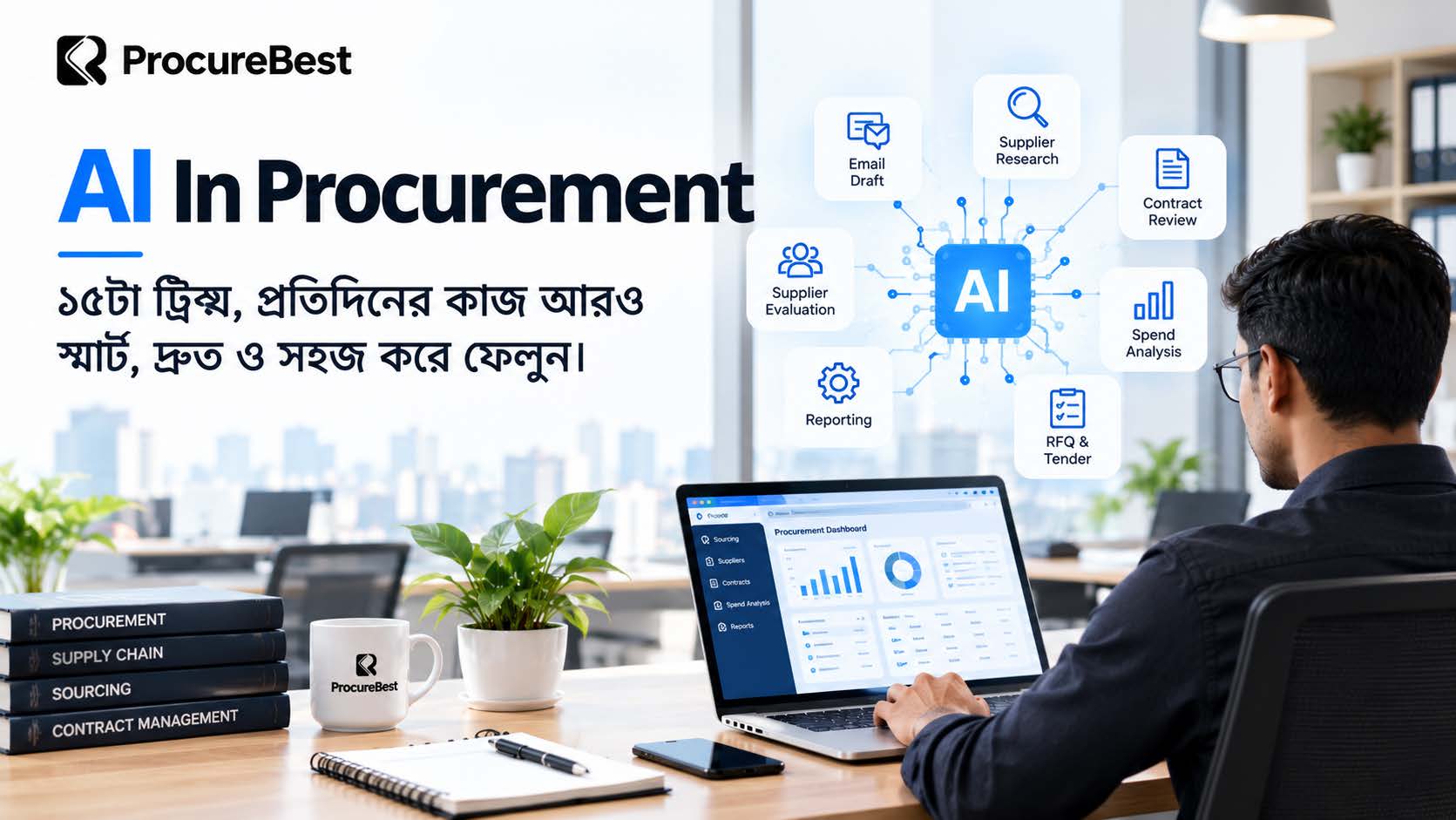
Let’s make one thing clear from the beginning: AI will not select suppliers or approve contracts on your behalf. It will save your time, organize information and help you prepare better before making decisions.
Procurement professionals know how many different tasks they have to handle every day. Supplier communication, RFQ preparation, Quotation Analysis, Price Comparison, Negotiation Preparation, Purchase Requisitions, Contract Reviews, Spend Analysis and Inventory Monitoring—managing all these activities takes up a significant part of the working day. Some tasks are highly important and require professional experience and judgment. However, many other tasks are repetitive and time-consuming, even though they do not always require extensive human effort.
This is where Artificial Intelligence (AI) can play an important role.
AI is no longer a tool used only by technology professionals. Buyers, Procurement Executives, Sourcing Specialists and Supply Chain Managers can also use AI in their everyday work.
The question is: Which AI tools should you use for different procurement tasks? How can you use them? And what practical benefits can you expect?
Let's explore 15 practical ways AI can support the daily responsibilities of a Procurement Professional.
1. Supplier Communication & Email Management
One of the most frequent responsibilities in procurement is communicating with suppliers. Requesting quotations, following up on deliveries, sending payment reminders, seeking technical clarification and negotiating prices—all these activities require different types of emails.
AI tools you can use:
- ChatGPT
- Microsoft Copilot
- Gemini
How can they help? Simply describe your objective and situation. AI can help you prepare a professional email draft. For example, a supplier has promised to submit a quotation but has failed to do so on time.
You can use this prompt:
Write a professional follow-up email to a supplier who has not submitted the quotation despite two previous reminders. Keep the tone firm but polite and request submission within the next 24 hours.
You can also use AI to prepare Price Reduction Requests, Delivery Delay Notices, Payment Follow-ups and Meeting Invitations.
Practical benefit: You can reduce the time spent writing repetitive emails and make your supplier communication more standardized.
2. RFQ, RFP & Tender Document Preparation
A good RFQ should clearly define the Scope of Supply, Technical Specifications, Commercial Terms, Delivery Schedule, Warranty and Payment Terms. AI can help you prepare the initial draft.
Tools:
- ChatGPT
- Gemini
- Microsoft Copilot
How can you use them?
Suppose your organization needs to purchase an industrial pump.
You can ask AI:
Prepare an RFQ draft for purchasing an industrial water pump. Include technical specifications, capacity, material requirements, warranty, delivery terms, installation requirements, commercial conditions and supplier submission requirements. Highlight any missing technical information separately.
AI can prepare an initial RFQ structure for you. However, Technical Specifications and Procurement Requirements must be reviewed by the relevant Engineer or Technical Team before the document is finalized.
3. Quotation Analysis & Price Comparison
Comparing quotations from different suppliers is one of the most important responsibilities of a Buyer. Sometimes you may receive quotations from 5–10 suppliers. One supplier may offer a lower price, another may provide a better delivery time, while another may offer a longer warranty. Analyzing all this information together can be time-consuming.
AI tools you can use:
- ChatGPT Data Analysis
- Microsoft Copilot in Excel
How can they help?
You can upload supplier quotations to an AI tool in Excel or CSV format.
Then use this prompt:
Analyze these supplier quotations and prepare a comparison table covering unit price, total price, delivery time, payment terms, warranty and technical compliance. Identify missing information, deviations and potential risks. Do not recommend a supplier based on price alone.
AI can help you prepare a Comparison Table and separately identify Missing Information and Potential Risks. This makes it easier to notice important factors before making a procurement decision.
4. Excel Formulas, Data Cleaning & Reporting
Many procurement activities depend heavily on Excel. For example:
- Purchase Tracking
- Supplier Database
- Spend Analysis
- Monthly Procurement Reports
- Inventory Monitoring
- Budget vs Actual Analysis
Many Procurement Professionals know how to use Excel but struggle with Advanced Formulas, Pivot Tables or Dashboard preparation. ChatGPT and Microsoft Copilot in Excel can be particularly useful in these situations.
Example:
Create an Excel formula to calculate the percentage difference between the last purchase price and the current quoted price. Highlight increases above 10%.
You can also ask:
Analyze this purchase history and identify items with frequent price increases, unusual purchasing patterns and potential duplicate transactions.
ChatGPT or Copilot can help analyze data, create formulas, identify trends and prepare reports. However, you should always verify the results of formulas and calculations.
5. Supplier Evaluation & Performance Analysis
A supplier should not be evaluated based on price alone. Several other factors are equally important:
- On-time Delivery
- Product Quality
- Response Time
- Lead Time
- Payment Terms
- After-sales Service
- Compliance
AI can help you analyze Supplier Performance Data.
Example: Suppose your organization has performance data for 20 suppliers covering the last 12 months.
You can ask AI:
Analyze the supplier performance data. Compare delivery performance, rejection rates, response time and pricing trends. Identify suppliers requiring corrective action and explain the reasons based on available data.
This can help you identify which suppliers are improving, which ones repeatedly delay deliveries and where quality issues are more frequent. However, Supplier Ratings and Final Evaluations should always follow your organization's established criteria.
6. Contract Review & Risk Identification
Even a small ambiguity in a procurement contract can create significant problems. Some particularly important areas include:
- Delivery Obligations
- Payment Conditions
- Warranty
- Penalty Clause
- Liquidated Damages
- Termination Conditions
- Force Majeure
You can use ChatGPT or an organization-approved Contract Management AI tool for an initial review.
Prompt:
Review this procurement contract and identify unclear clauses, missing commercial conditions, delivery-related risks, warranty gaps and potential supplier obligations. Present the findings in a table with clause references. Do not provide a final legal opinion.
AI can help identify important clauses and potential concerns during the initial review. However, Final Contract Approval must always be handled by the Legal Team and Authorized Management.
7. Market Research & New Supplier Sourcing
Finding new suppliers and understanding the market are important procurement responsibilities. AI can work as a Research Assistant in this process.
Tools:
- ChatGPT
- Gemini
- Perplexity
Example: Suppose your organization needs industrial safety equipment.
Prompt:
Research potential manufacturers and suppliers of industrial safety equipment in Bangladesh and international markets. Categorize them by product range, manufacturing capability, certifications and available public business information. Provide source links and distinguish verified facts from unverified information.
You can use AI to start the initial Market Research process. However, the existence of suppliers, their manufacturing capabilities, certifications and business reputation must be independently verified.
8. Negotiation Preparation
Price reduction is not the only objective of procurement negotiation. Payment Terms, Delivery Schedule, Warranty, MOQ and Long-term Business Benefits are also important. AI can help you prepare before entering a negotiation.
Tools:
- ChatGPT
- Gemini
Prompt:
Act as a procurement negotiation coach. Based on this supplier quotation, our target price, market information and required delivery schedule, prepare a negotiation strategy. Identify possible supplier objections, alternative proposals and questions I should ask.
AI can help you prepare possible Negotiation Scenarios, questions and Alternative Proposals. You can even practice a Mock Negotiation with AI by responding to possible supplier objections.
This can help you feel better prepared before an actual negotiation meeting.
9. Spend Analysis & Cost Saving Opportunities
One of the major responsibilities of procurement is controlling organizational spending. However, the same products are sometimes purchased at different prices through different departments, locations or suppliers.
AI can help analyze Historical Purchase Data.
Prompt:
Analyze our annual procurement spend by category, supplier and department. Identify duplicate purchasing patterns, price variations, high-spend categories and potential consolidation opportunities.
AI can help you understand which categories account for higher spending, where Price Variations exist and where opportunities for Consolidation may be available. This can support Strategic Sourcing and Cost Optimization activities.
10. Inventory Management & Demand Forecasting
When will an item run out of stock? Which items are overstocked? When should a new order be placed? These questions are directly connected to Procurement and Inventory Management. AI and Data Analytics can help with these activities.
Tools:
- ChatGPT Data Analysis
- Microsoft Copilot in Excel
- AI features in your organization's ERP or Inventory Management System
Prompt:
Analyze the last 12 months of inventory consumption data. Identify fast-moving and slow-moving items, seasonal demand patterns, potential stockout risks and possible reorder planning requirements.
AI can help identify patterns and potential issues from Historical Data. However, Forecasting Accuracy depends on Data Quality, Lead Time, Seasonality and Demand Patterns.
11. Purchase Order & Invoice Checking
Matching information between a Purchase Order (PO), Supplier Invoice and Goods Received Note (GRN) is extremely important. Many organizations still perform these activities manually.
AI and Automation in Enterprise Procurement Systems can help with:
- Invoice Data Extraction
- PO Matching
- Duplicate Invoice Identification
- Quantity Difference Detection
- Price Variance Identification
SAP's Procurement AI solutions include use cases related to Invoice and Contract Management Automation. However, identifying a discrepancy does not automatically mean that fraud has occurred. Proper verification is always necessary.
12. Procurement Reporting & Management Presentations
At the end of daily activities, procurement professionals often need to prepare reports for management. These may include Weekly Procurement Reports, Monthly Spend Reports or Cost Saving Presentations. AI can help prepare the initial draft of these reports.
Prompt:
Convert this monthly procurement performance data into an executive summary. Include procurement spend, savings, supplier performance, delayed orders, key risks and recommended actions. Keep the language concise and management-friendly.
ChatGPT or Copilot can help prepare Summaries, Tables, Charts and Presentation Content. This can reduce the time spent preparing reports and allow more attention to Data Interpretation and Decision Support.
13. SOP & Process Improvement
Many organizations have SOPs (Standard Operating Procedures) for different procurement activities. However, preparing, updating and regularly reviewing SOPs can be time-consuming.
AI can help prepare:
- Procurement SOP Drafts
- Purchase Approval Workflows
- Supplier Onboarding Checklists
- Procurement Policy Summaries
- Process Gap Identification
Prompt:
Review this procurement process and identify unnecessary steps, approval bottlenecks, documentation gaps and opportunities for process improvement. Suggest a simplified workflow without compromising internal controls.
AI can also support Lean and Continuous Improvement activities.
14. Procurement Learning & Professional Development
AI is not only useful for daily tasks; it can also help you improve your professional skills. For example:
- Learning CIPS topics in simpler language
- Preparing Procurement Case Studies
- Practicing Negotiation
- Learning Contract Management
- Understanding Supply Chain Concepts
- Interview Preparation
- Developing Procurement Technical Knowledge
You can use ChatGPT and Gemini as your Personal Learning Assistant.
Prompt:
Act as an experienced procurement trainer. Teach me Strategic Sourcing through practical case studies. Ask me questions, evaluate my answers and explain where my procurement decisions could improve.
Even spending 15–20 minutes a day on this type of learning can be a useful routine. (This is a suggested routine, not a research-based finding.)
15. Procurement Automation & AI-Powered Enterprise Solutions
So far, we have mainly discussed General AI Tools such as ChatGPT, Gemini and Excel Copilot. However, larger organizations are also using more advanced AI-powered procurement solutions.
SAP Joule / SAP Business AI SAP's Procurement AI solutions include use cases such as creating Sourcing Events, RFP Analysis, Supplier Bid Review, Contract Tasks and searching for Supplier Information.
Coupa Coupa is an Enterprise Spend Management and Procurement Platform. Its AI-related capabilities are designed to support organizations with Spend Visibility, Procurement Workflows and Risk Management.
Ivalua Ivalua's AI-enabled Procurement Platform supports activities across Sourcing, Supplier Management, Contract Management, Spend Analysis and Source-to-Pay Workflows.
These types of Enterprise Solutions are generally connected to an organization's ERP, Procurement Data and Internal Workflows. Therefore, they are different from using general-purpose tools such as ChatGPT.
Which AI Tool Should You Use for Which Procurement Task?
| AI Tool | Procurement Applications |
|---|---|
| ChatGPT | Email, RFQ Drafting, Data Analysis, Negotiation Preparation |
| Gemini | Research, Document Analysis, Writing and Learning |
| Microsoft Copilot | Excel Analysis, Formulas and Reporting |
| Perplexity | Market Research and Source-based Information Search |
| SAP Joule | Enterprise Sourcing, Supplier and Procurement Workflows |
| Coupa | Enterprise Spend Management and Procurement |
| Ivalua | Sourcing, Contract and Supplier Management |
Note: Not every feature is available with every subscription or organizational software configuration.
5 Things to Remember When Using AI in Procurement
AI can help you work faster. However, using it incorrectly can also create new risks.
1. Do Not Share Confidential Data Do not upload a supplier's Confidential Quotation, Contract, Bank Information, Employee Data or your organization's Sensitive Commercial Information to a public AI tool without proper authorization.
2. Verify AI-generated Information AI can provide incorrect information, inaccurate formulas or even non-existent references. Technical Specifications, HS Codes, Tax, Customs and Legal Information must be carefully verified.
3. Keep Final Decision-making in Human Hands Supplier Selection, Contract Approval, Purchase Authorization and Financial Commitments should never be left entirely to AI.
4. Give AI Clear Instructions The clearer your Context, Objective and Expected Output, the more useful the results are likely to be.
5. Follow Your Organization's AI Policy Always follow your organization's policies regarding which tools can be used, what data can be shared and where Human Approval is mandatory.
Final Thoughts: Knowing How to Use AI Is Becoming an Important Procurement Skill
Procurement professionals spend a significant amount of time on tasks that can be completed faster and more efficiently with the support of AI.
However, the purpose of using AI should not be limited to increasing work speed. It should allow Procurement Professionals to spend more time on Strategic Sourcing, Supplier Relationships, Negotiation, Cost Optimization, Risk Management and Business Decision Making.
If a Buyer can use AI for daily Email Drafting, Quotation Comparison, Excel Analysis and Report Preparation, the way they work can change significantly.
For the next generation of Procurement Professionals, having Procurement Knowledge alone may not be enough. Skills in Data Analysis, Digital Tools and AI Applications will also become increasingly important.
One question before you go: Which daily procurement task would you like to make easier with AI?
Share your experience and the AI tools you use in the comments.
Author: Mohammad Solaiman Aulia LinkedIn Profile